
Join Us on Apr 30: Unveiling Parasoft C/C++test CT for Continuous Testing & Compliance Excellence | Register Now

Solutions
The Parasoft Continuous Quality Testing Platform: AI-Powered Test Automation Solutions


Deliver High-Quality & Secure Software
Today’s “continuous everything” DevOps workflows require quick software releases. Yet you can’t afford to let your
software go untested. Parasoft’s AI-powered platform integrates automated test execution and deep code analysis
into your development process. You get high-quality software out the door faster—and at lower costs.
Deploy complete SDLC test automation, including static analysis, unit testing, code coverage, API testing, UI testing, security testing, load and performance testing.
Simply create, run, maintain, and reuse common sets of testing suites to collaborate and scale continuous testing across the organization.
Comprehensive support for the latest regulatory and compliance standards ensures the delivery of safety- and security-critical software at speed.
Flexible platform and extensive native integrations make incorporating testing into existing builds and delivery pipelines easy.
Cutting-edge AI-powered, ML-driven software testing solutions enable fast and efficient test creation and execution.
View aggregated results across testing practices for intelligent and real-time monitoring of testing outcomes and visibility across teams and projects.
Safety & Security-Critical Testing
Simplify testing your code for safety- and security-critical systems against regulatory requirements and compliance standards.
Static Code Analysis
Identify and remediate complex runtime errors with static analysis techniques to improve code quality, reliability, and security.
Learn More »Unit Testing
Automatically generate test cases to streamline verification of code functionality and compliance with safety and security standards.
Learn More »Structural Code Coverage
Demonstrate the completeness of unit, integration, and system-level testing with detailed code coverage reports.
Learn More »Functional Safety Compliance
Automate testing to ensure software quality requirements are met for functional safety compliance.
Learn More »Requirements Traceability
Provide proof that requirements for functional safety standards are implemented correctly and covered by tests.
Learn More »Reporting & Analytics
Track risk and software quality with robust reporting and dynamic dashboards that provide visibility into compliance progress.
Learn More »API, Web, & Cloud Testing
Deliver service-centric web applications with confidence using the Parasoft Continuous Quality Testing Platform for end-to-end test automation.
API Testing
Seamlessly integrate AI-powered API and microservices testing into your CI/CD workflow.
Learn More »Load & Performance Testing
Apply load and performance testing to validate application usage under strenuous conditions.
Learn More »API Security Testing
Gain immediate feedback and visibility about potential vulnerabilities to ship your software with confidence.
Learn More »Service Virtualization
Eliminate test environment dependencies with virtual test data and service virtualization solutions.
Learn More »Web UI Testing
Ensure web-based interactions are flawless and frustration-free to meet high user expectations.
Learn More »Reporting & Analytics
Identify testing gaps and risks in the analytics dashboard and drill down into reports to determine mitigation actions.
Learn More »Application Security Testing
Simplify application security testing in development workflows with automated testing.
Reporting & Analytics
Identify testing gaps and risks in the analytics dashboard. Drill down into robust reports to determine mitigation actions.
Learn More »Static Code Analysis
SAST techniques identify and remediate application vulnerabilities to improve code quality, reliability, and security.
Learn More »API Security Testing
Automate dynamic application security testing (DAST) with penetration testing to uncover security and quality issues in applications.
Learn More »Security Testing
Identify and remediate vulnerabilities to improve the quality and security of software applications in all phases of the software development process.
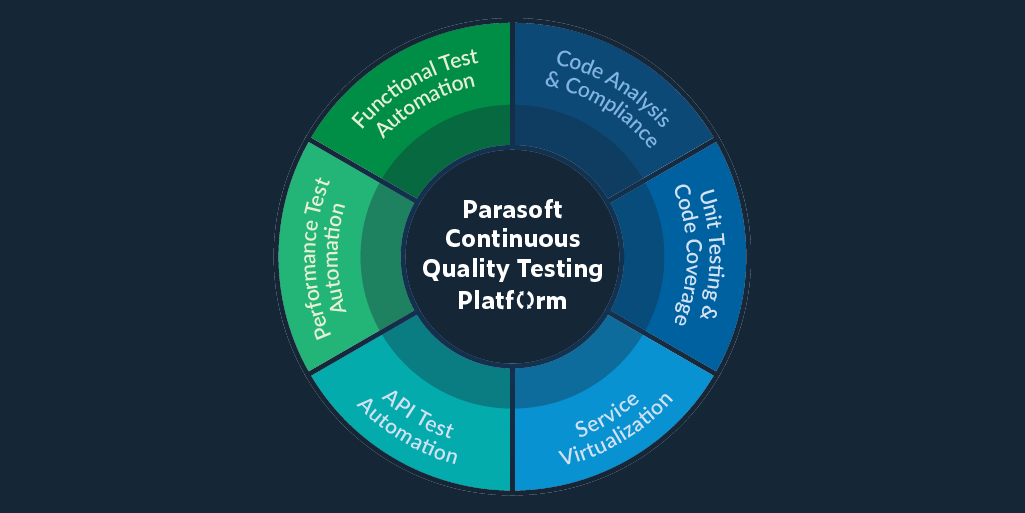
Learn More »Continuous Quality Testing Platform
Integrate test automation throughout the SDLC to deliver software fast with confidence that it’s of high quality.
Static Code Analysis
Improve code quality, reliability, and security with static analysis techniques.
Learn More »Unit Testing
Verify code functionality and compliance with safety and security standards.
Learn More »API Testing
Seamlessly integrate AI-powered API and microservices testing into your CI/CD workflow.
Learn More »Load & Performance Testing
Apply load and performance testing to validate application usage under strenuous conditions.
Learn More »API Security Testing
Gain immediate feedback and visibility about potential vulnerabilities to ship your software with confidence.
Learn More »Service Virtualization
Eliminate test environment dependencies with virtual test data and service virtualization solutions.
Learn More »Web UI Testing
Ensure web-based interactions are flawless and frustration-free to meet high user expectations.
Learn More »Reporting & Analytics
Verify test results meet expectations and identify any gaps on the reporting and analytics dashboard.
Learn More »Automotive
Finance
Healthcare & Insurance
Hospitality & Travel
Medical Devices
Military & Defense
Public Sector
Telecommunications

Renovo Balances Speed & Agility With Safety & Security in ADAS Development
Renovo was able to reduce time to market by quickly achieving 100% AUTOSAR C++14 and CERT compliance through detecting bad coding practices, vulnerabilities, potential intrusions, and memory problems early in the SDLC using Parasoft’s testing solution.
-

-
-


AI-Driven Java Unit Testing Boosts Developer Productivity for Financial Firm
Using Parasoft’s AI-enabled Jtest, this leading financial team was able to increase developer productivity and dramatically improve code quality.
-

-

-


WoodmenLife Redefines Testing to Reach Quality Goals
Leveraging Parasoft solutions, WoodmenLife implemented a true test management process to achieve CI/CD with quality embedded into their workflow.
-
-

-

Test the Untestable: Alaska Airlines Solves the Test Environment Dilemma
Alaska Airlines leverages service virtualization to efficiently scale testing for their complex flight operations application.
-

-
-

Smiths Medical Delivers Safe, High-Quality Medical Devices With Test-Driven Development
Smiths Medical leveraged Parasoft C/C++test to evolve their software testing to test-driven development and achieve more than 70% code coverage.
-
-
-


Federal Agency Fulfills Rigorous DO-178C Standard With Unified Automated Testing Solution
The federal agency leveraged automated testing technologies from Parasoft to efficiently deliver safe, secure avionics systems and maximize testing ROI.
-
-
-

Justid Delivers High-Quality Applications Fast With Load & Performance Testing
Justid performs load and performance tests with Parasoft, which gives their teams a quality indicator on the technical properties of the applications and ensures their partners and customers that the applications successfully passed the sequential quality checks.
-
-
-

Comcast Deploys DevOps, Service Virtualization, & Performance Testing
Comcast adopted service virtualization enabling them to achieve continuous testing as an integral part of their DevOps process.
-

-
-
Solutions for Every Compliance Need
It’s not enough for code to be innovative. It must behave as expected — and be safe, reliable, and secure. To meet this growing list of requirements, industries mandate that a variety of coding, functional safety, and security standards be baked into the coding process. Parasoft’s automated software testing tools continuously analyze code to ensure compliance.
Technology Integrations
Parasoft integrations are seamless, extensive, and continuously growing, so organizations can deploy the best software
development and test ecosystems to face today’s quality, cost, and productivity challenges.

 C/C++test
 dotTEST
  DTP
DTP  Jtest
Jtest  SOAtest
  Virtualize
 Insure++
 CTP
CTP  Selenic



Elevate your software testing with Parasoft solutions.