Discover TÜV-certified GoogleTest with Agentic AI for C/C++ testing!
Get the Details »

Whitepaper
Before you jump in, start with the preview below.
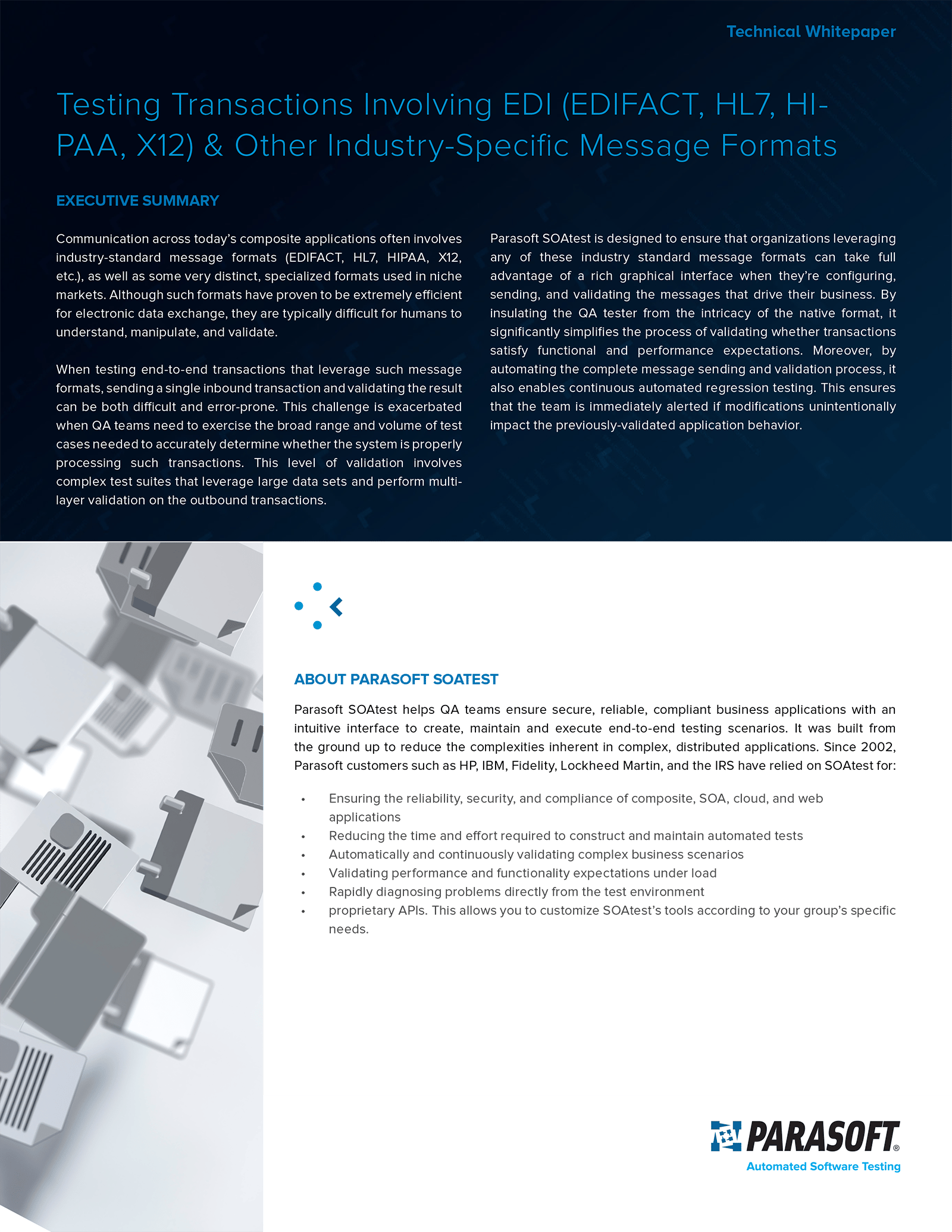
Communication across today’s composite applications often involves industry-standard message formats (EDIFACT, HL7, HIPAA, X12), as well as some very distinct, specialized formats used in niche markets. Although such formats have proven to be extremely efficient for electronic data exchange, they are typically difficult for humans to understand, manipulate, and validate.
When testing end-to-end transactions that leverage such message formats, sending a single inbound transaction and validating the result can be both difficult and error-prone. This challenge is exacerbated when QA teams need to exercise the broad range and volume of test cases needed to accurately determine whether the system is properly processing such transactions. This level of validation involves complex test suites that leverage large data sets and perform multilayer validation on the outbound transactions.
Parasoft SOAtest is designed to ensure that organizations leveraging any of these industry standard message formats can take full advantage of a rich graphical interface when they’re configuring, sending, and validating the messages that drive their business.
By insulating the QA tester from the intricacy of the native format, it significantly simplifies the process of validating whether transactions satisfy functional and performance expectations. Moreover, by automating the complete message sending and validation process, it also enables continuous automated regression testing. This ensures that the team is immediately alerted if modifications unintentionally impact the previously-validated application behavior.
Parasoft SOAtest helps QA teams ensure secure, reliable, compliant business applications with an intuitive interface for creating and executing end-to-end testing scenarios. Built to reduce complexities in distributed applications, it has been trusted by customers like HP, IBM, Fidelity, and Lockheed Martin since 2002.
SOAtest enables organizations to rapidly configure, send, and validate virtually any text-format message via an intuitive, form-based interface. With SOAtest’s support for a broad scope of native formats, organizations can take advantage of its wide variety of tools for performing sophisticated construction or validation of messages.
Parasoft SOAtest offers support for a wide array of EDI message formats used in retail, healthcare, government, and more. Dialect, version, and message type are detected automatically. Supported formats include:
SOAtest provides flexible fixed-length message format support. Since many different formats exist, SOAtest is easily configured to recognize any fixed-length message format your organization uses, enabling rich interface message configuration, sending, and validation.
SOAtest’s UI is preconfigured to facilitate rapid configuration, sending, and validation of CSV messages.
Parasoft provides a framework that allows you to extend the solution’s built-in support for protocols including DDS, plain socket, TCP/IP-based messaging, file-based messaging, and proprietary API-based messaging. This allows customization according to your group’s specific needs.

Ready to dive deeper?