

Discover TÜV-certified GoogleTest with Agentic AI for C/C++ testing!
Get the Details »
Jump to Section
Parasoft Blog


Is your team struggling to balance speed and quality in safety-critical software? Traditional static analysis tools can create more problems than they solve by producing excessive violations. Read on to discover how embedding ML and GenAI changes the game.
Jump to Section
In today’s embedded and safety-critical software development landscape, teams are under pressure to deliver faster while maintaining high standards for quality, security, and compliance. Traditional static analysis workflows often create their own bottlenecks: thousands of violations, limited context, and labor-intensive remediation.
Parasoft is tackling these challenges with a modernized, intelligent approach, embedding machine learning (ML) and generative AI (GenAI) into its software testing solutions. These innovations are more than upgrades. They represent a transformative leap in how teams prioritize and fix static analysis violations in complex systems.
Before AI and ML can go to work, building safety-critical code starts with deep, accurate static analysis. Parasoft’s C/C++test is built on a mature, proven engine that delivers full, standards-compliant violation detection out of the box. C/C++test fully supports a broad range of industry standards, including MISRA C:2025, MISRA C++:2023, AUTOSAR C++14, CERT C/C++, CWE, and more. These standards are essential for teams building applications where safety, security, and reliability cannot be compromised.
What sets us apart is not just the breadth of support, but the depth of configuration and control. Organizations can tailor rule enforcement to match specific project goals, system criticality, or legacy code realities. Rules can be enabled, disabled, customized, or grouped by compliance requirements. Even entirely new rules can be created using Parasoft’s RuleWizard.
Development teams also get support for data flow analysis and control flow analysis. These tests offer comprehensive insights into potential runtime risks like null pointer dereferences, buffer overflows, or concurrency issues—long before they manifest in testing or production.
This static analysis engine doesn’t operate in isolation. It seamlessly integrates into CI/CD pipelines, developer IDEs, and our centralized reporting platform, Parasoft DTP (Development Testing Platform). Whether you’re doing shift-left testing in your IDE or enforcing policies in a CI job, Parasoft finds violations early, accurately, and in context.
Once your development team identifies the violations, the challenge becomes, which ones do you fix first? We answer that with an embedded machine learning engine in DTP. This ML engine learns from:
It uses that behavior to rank and prioritize new findings.
ML captures each developer’s interactions with reported violations using DTP’s centralized analytics hub. DTP begins building a behavioral model for issues marked as fixed, suppressed, deviated, or reassigned. This model evolves with each sprint, learning how your team prioritizes different types of violations based on severity, risk, and history.
For new users, the model can be trained manually. Developers categorize and act on violations sprint by sprint, teaching the system to distinguish what matters most.
Existing Parasoft customers experience the benefits immediately. We use historical data to train the model instantly, reflecting years of real-world decisions.

Model training
This ML-driven prioritization allows teams to focus first on violations with the highest remediation value, those most likely to affect safety, functionality, or compliance. Instead of being overwhelmed by a sea of warnings, developers see the top issues that must be fixed now, enabling smarter triage and better use of engineering time.
In domains where compliance with standards like MISRA, CERT, ISO 26262, or DO-178C is mandatory, this capability streamlines audits and reporting. Teams can demonstrate that they’re focusing on mandatory rules first and documenting justified deviations for others without trying to fix every violation blindly.
After ML prioritizes the most important violations, engineering teams can remediate them using AI-assisted workflows designed specifically for embedded and safety-critical software development. Rather than relying on generic code generation alone, Parasoft extends C/C++test with MCP-enabled agentic AI workflows that combine standards-aware static analysis intelligence with configurable AI skills.
AI skills provide structured workflows and contextual guidance that enable agents to:
The workflows are tightly integrated into developer environments and CI/CD pipelines, enabling organizations to modernize remediation activities while maintaining engineering oversight and compliance traceability.
Unlike generic AI coding assistants that may generate syntactically correct but noncompliant code, Parasoft’s approach enriches AI interactions with detailed contextual information derived directly from the static analysis engine. This includes:
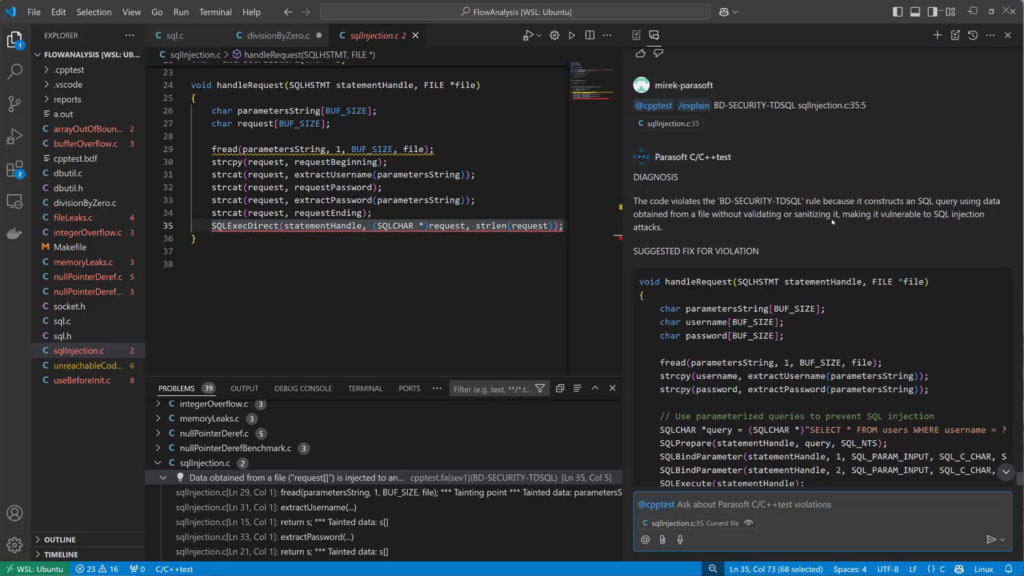
Static analysis remediation with AI-assisted workflows
This standards-aware context allows AI agents to generate more accurate and compliant remediation proposals aligned with embedded software quality and safety objectives.
AI-assisted remediation workflows help developers:
The AI-generated updates remain fully reviewable by developers before acceptance, ensuring that human oversight and engineering judgment remain central to the verification process. This is especially important in safety-critical industries where compliance, traceability, and deterministic verification activities are required.
These capabilities transform static analysis remediation from a labor-intensive manual process into a modern intelligent workflow. Organizations improve productivity, reduce technical debt, and accelerate compliance activities without sacrificing software quality or control.
By combining ML prioritization and GenAI remediation, Parasoft offers more than just automation. It delivers intelligent guidance throughout the static analysis life cycle. Teams no longer waste time chasing low-priority issues or rewriting obvious fixes. Instead, they focus on what’s important, fix it the right way, and move forward with confidence.
This intelligent approach accelerates development, reduces the cost of defects, and simplifies the path to compliance, all while enabling teams to make informed, traceable decisions that stand up to audits and certifications.
Whether you’re building the next autonomous vehicle system, a medical monitoring device, or mission-critical avionics, Parasoft’s AI-powered testing suite is built to meet the challenge.
While Parasoft’s AI and ML innovations streamline violation prioritization and remediation, we also focus on simplifying how developers interact with the tooling itself. Documentation has always played a critical role in tool adoption, but for many users, especially those new to compliance-heavy workflows, finding relevant answers buried in long technical manuals can be frustrating and time-consuming.
To solve this, Parasoft introduced a built-in AI-based documentation assistant in C/C++test 2025.1. Integrated directly into the developer’s IDE, this assistant responds to goal-oriented questions. Here are a couple of examples.
Instead of navigating through menus or scanning lengthy guides, developers get focused, contextual answers, complete with direct links to the relevant sections of the documentation. This dramatically shortens the learning curve and helps teams become productive much faster.

AI-powered user assistance
The AI Documentation Assistant provides three major benefits:
This assistant is another example of how Parasoft is bringing AI to every layer of the software testing experience, not just to detect or fix code, but to empower users through intelligent, responsive support.
Parasoft modernizes the entire static analysis life cycle by embedding artificial intelligence and machine learning into our C/C++ testing solution. From detecting and prioritizing violations to accelerating remediation and improving user adoption through an AI-powered documentation assistant, these innovations amplify human decision-making with intelligent tools that adapt, guide, and evolve alongside your team.
Whether you’re developing next-generation automotive ECUs, avionics control systems, or medical device firmware, Parasoft equips you with smarter tools, safer code, and faster results to meet today’s software quality challenges with clarity, efficiency, and confidence.
Take a deep dive into the advancements of AI/ML in embedded safety-critical systems.


